Quick answer: For opening, prying, and measuring — the jobs most keychains actually face — an 8 g titanium pry bar does the work at a fraction of the weight of a typical 40–90 g stainless steel multi-tool. If you regularly need pliers, scissors, or a blade, a multi-tool earns its bulk; if you mostly open packages and bottles, it usually stays in a drawer.
Keychain carry is a weight negotiation. Every tool you add is another few grams swinging against your pocket, and one oversized multi-tool can undo the whole idea of carrying less. The interesting question is not which tool is more capable in theory, but which capability you actually use.
Why eight grams matters more than it sounds
A key ring already holds enough weight between keys and a fob. Adding a 60–90 g multi-tool turns the ring into a pocket weight you feel every time you sit down or drive. An 8 g pry bar is about the same weight as two house keys, so it stops being a decision: it stays on the ring and is there when a bottle or a taped box appears.
That difference is also why lightweight tools tend to get used more. A tool that lives in a drawer is not part of your carry, no matter how many functions it lists.
Head-to-head: 8 g titanium vs. typical stainless multi-tool
| Spec | SHOWHOLI titanium pry bar | Typical stainless keychain multi-tool |
|---|---|---|
| Weight | 8 g | 40–90 g depending on model |
| Material | Grade 5 titanium (Ti-6Al-4V) | Stainless steel |
| Corrosion resistance | Excellent — no rust from sweat or salt water | Good, but can spot or pit in salt and sweat |
| Functions | Pry tip, bottle opener, ruler markings | Pliers, scissors, blade, drivers, opener |
| Keychain footprint | 60 mm long, 15 mm across | Usually 70–100 mm long and much thicker |
| Air travel | Blade-free, under 7 inches — generally carry-on friendly | Usually includes a blade — must be checked |
| Typical price | $21.99 | Roughly $30–$100 |
| Best for | Minimal keys, travel, light daily prying | Repair tasks that need pliers or a blade |
Weights and prices vary by model and brand. The stainless range reflects common keychain-size multi-tools, not full-size workshop tools.
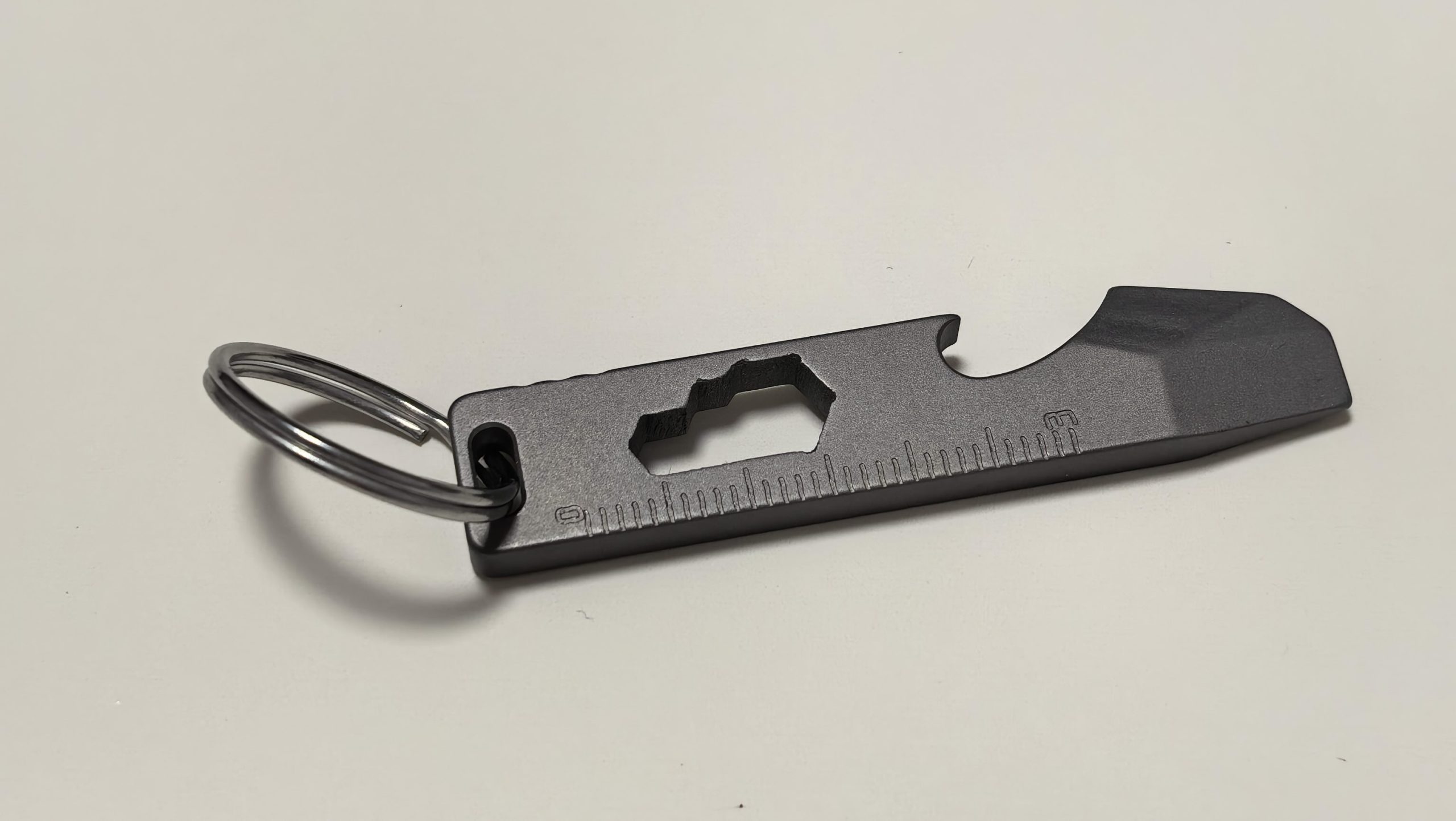
Titanium vs. stainless steel: what the materials actually do
- Weight: titanium has a density of about 4.5 g/cm³ versus roughly 7.8 g/cm³ for steel. The same shape in titanium weighs about 40% less.
- Corrosion: titanium forms a stable oxide layer and does not rust in sweat, rain, or salt water. Stainless steel resists rust well, but prolonged salt exposure can still leave spots.
- Strength: Grade 5 titanium is genuinely strong for its weight, but hardened stainless steel is harder. A titanium pry bar is not a replacement for a steel wrecking bar.
- Feel: titanium is warmer in the hand than steel, and a sandblasted finish hides small scratches instead of showing every scuff.
The honest summary: titanium wins on weight and corrosion, stainless wins on hardness and cost per gram. For a tool that lives on a key ring, the first two matter more.
What a keychain tool actually needs to do
Look at the last twenty times you reached for a tool. The list usually looks like this:
- Opening a bottle or a package.
- Lifting a lid, a battery door, or a tight panel.
- Checking a quick measurement.
- Scraping or separating something without a screwdriver.
An 8 g pry bar covers all four. Pliers, scissors, and a blade cover different jobs — jobs that show up less often for most people, and that are better handled by a proper tool when they do.
The travel angle is worth repeating: a blade-free pry bar under 7 inches is generally allowed in carry-on, while a multi-tool with any blade has to be checked. If you fly with a personal item only, that single difference can decide which tool comes with you. Our TSA rules guide covers the details.
The hidden cost of “just in case” tools
Multi-tools are sold on the idea that more functions mean more preparedness. In daily life the opposite often happens: the tool is heavy, so it moves to a bag or a drawer, and the functions you paid for are never used. A single-purpose tool you actually carry beats a ten-function tool you leave at home, every time.
That is the case for the 8 g titanium keychain pry bar: one solid piece, three useful functions, no blade, and no excuse to leave it behind.
Frequently asked questions
Is an 8 g pry bar strong enough for everyday use?
Yes for light daily jobs such as lifting lids, opening packaging and prying small panels. It is not a replacement for a full-size pry bar or for automotive work.
Why choose titanium over stainless steel for a keychain tool?
Titanium is roughly 40% lighter than steel at comparable strength and resists sweat and salt water without rusting. Stainless steel is harder and cheaper, but a small stainless multi-tool usually weighs 40 g or more.
Will a metal pry bar scratch my keys or phone?
The sandblasted finish is smooth, but any metal tool can scuff a screen or painted surface if it rubs against it. Keep the pry bar on your key ring and your phone in a separate pocket.
See the SHOWHOLI Titanium EDC Pry Bar Multi-Tool — 8 g instead of 40+ g.